
NotebookLM export guide
Export NotebookLM Flashcards to JSON
Download NotebookLM flashcards as structured JSON containing the deck title and front-and-back card records for code, automation and custom study tools.
Chrome extension · Review generated content before publishing or grading
Quick answer
How to export flashcards from Gemini Notebook to JSON
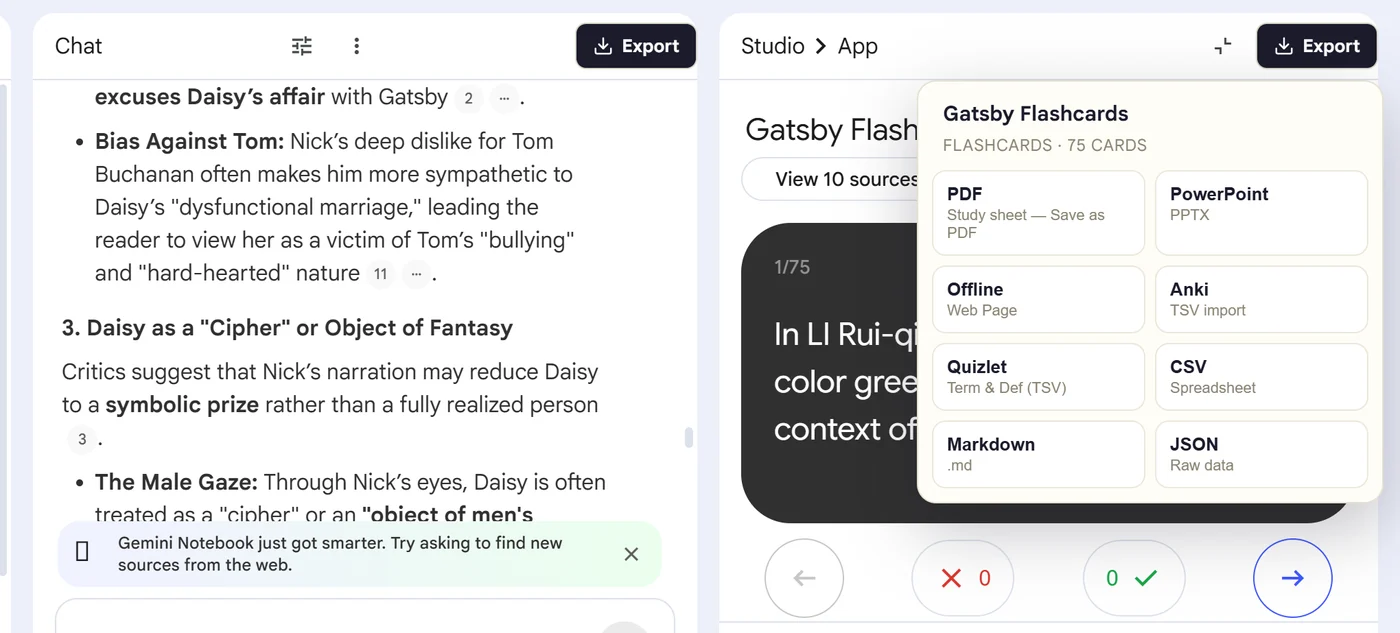
First, install the Super NotebookLM Exporter Chrome extension linked on this page. Next, open NotebookLM Studio, select the flashcard set and wait for the card canvas to load. Locate the Export ▾ button at the top of the flashcard canvas. Then, open the menu and choose JSON. Finally, download the .json file, validate it and map the deck title plus front-and-back card records into your application.
Why export it?
Why export?
Applications and automation need named fields, not a visual deck or loosely structured document. JSON gives developers a clear deck object and card records to validate and transform.
Native option check
Can Gemini Notebook handle this export natively?
NotebookLM natively downloads flashcards as CSV, not JSON. The extension's JSON output is intended for code, APIs, structured backups and custom study interfaces.
Product capabilities reviewed against current Google help documentation in August 2026.
✓
A JSON-ready file
✓
Front-and-back pairs stay together
✓
No card-by-card copy-paste
✓
A portable copy outside the notebook
Step-by-step guide
Download NotebookLM Flashcards as JSON in 5 Steps
Open NotebookLM Studio, select the flashcard set and wait for the card canvas to load
Locate the Export ▾ button at the top of the flashcard canvas
Open the menu and choose JSON
Download the .json file, validate it and map the deck title plus front-and-back card records into your application
Where it fits
Who uses this export workflow?
01
App development
02
Automation
03
Structured archives
04
Custom study tools
Common follow-up questions
What people need to know before using this export
What does the flashcard JSON contain?
It contains the deck title, a flashcard type marker and a list of cards with front and back values.
Can Anki import the JSON directly?
Not through Anki's standard text-import workflow. Use the dedicated Anki export or transform the JSON into an accepted format.
Is JSON better than CSV for backups?
JSON preserves explicit field names and a structured object. CSV is simpler for spreadsheet inspection and manual editing.
Questions, answered
FAQ
Can I export NotebookLM flashcards to JSON?+
Yes. Open the flashcard deck, select Export, choose JSON, and complete the destination's import or editing workflow.
Does NotebookLM already export flashcards?+
Gemini Notebook provides a native CSV download. The extension is useful for additional outputs and destination-ready formats.
Will terms and definitions stay paired?+
Yes. Each flashcard front is kept with its corresponding back in the exported structure.
Should I check formatting after import?+
Yes. Review long text, special characters, equations and line breaks because destination apps apply their own formatting rules.
Can NotebookLM natively download flashcards as JSON?+
NotebookLM's native flashcard download is CSV. Super NotebookLM Exporter adds JSON for structured backups, applications and automation.
Can I convert NotebookLM flashcard JSON to CSV?+
Yes. Flatten each front-and-back card record into a row, preserve UTF-8 encoding and review multiline definitions before writing the CSV.
Product references
Native-feature comparisons on this page were checked against Google's current Gemini Notebook help pages.
Ready when the artifact is
Export NotebookLM Flashcards to JSON
Download NotebookLM flashcards as structured JSON containing the deck title and front-and-back card records for code, automation and custom study tools.
Add to Chrome Extension